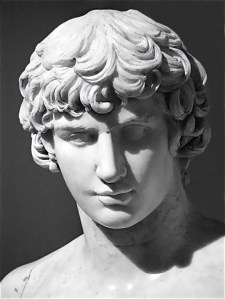
This blog entry is an ongoing in-depth interview between operamission’s director Jennifer Peterson and the two creators of a brand new full-length opera: Antinous and Hadrian, music by Clint Borzoni, libretto by Edward Ficklin. Read the interview below, and entries are being added every few days.
Please add your own questions or comments below, or you may tweet any of us – Clint • Eddy • operamission • Jennifer.
The Interview
Saturday, March 23, 2013, from Jennifer Peterson:
Hi Clint,
You and I first met in American Opera Projects’ ‘Composers & the Voice’ ongoing workshop series. In the first session you asked good questions, and I could tell you were an attentive and conscientious young artist. We’ve had a nice working relationship ever since…what year was that? And did you already know you wanted to compose opera at that point? Is that why you applied to AOP C&V?
And can you tell us a little about your initial inspiration to write a full-length opera on the love story of the Roman Emperor Hadrian and the youth Antinous? Was this something that was a personal connection for you, or was it a story you thought needed to be shared with the world, or both? What made you hear their story musically?
I have about 6,000 more questions, but that will get us started.
Thank you!
Jennifer
Monday, March 25, 2013, from Clint Borzoni:
Hey Eddy and Jen,
Thank you Jen. Saying we have a nice working relationship is an understatement. You are a friend, a colleague, and the foremost interpreter of my music. At the time we met at C&V, I didn’t know I wanted to be an opera composer. All I knew was that I wanted to learn more about writing for the voice. Since I started composing at eleven, I knew one day I wanted to write an opera, a symphony, a string quartet, and a piano concerto. Writing an opera was just a compositional goal. Through C&V and my residency with American Lyric Theater (ALT), I fell in love with the operatic medium.
The final assignment of C&V was to write an opera scene. I had no idea what I wanted to write about. I came across an article about homosexual romances throughout history, and the love Hadrian and Antinous shared moved me. I thought their story would make an intriguing opera since it contained passion, romance, politics, and tragedy. I wanted to write an opera that was about love. Most importantly, I wanted to write a love duet between two men. I personally wanted to hear and see two men singing to each other. To me, only opera can express the connection people share.
Clint
Friday, March 29, 2013, from Jennifer Peterson
That’s so interesting. I’m hoping this conversation will be able to uncover for our readers just how complex the creation of a full-length opera actually is.
I think people know it is an ominous task, and that it can take many years. But I don’t think people have any idea to what extent the creators invest their time and energies.
Well into our first year of working together, I remember vividly a libretto reading session hosted by AOP, led by director Ned Canty and conductor Steven Osgood. When it was your turn to describe the libretto you were thinking of setting, you described the opening scene of a beautiful love story. You first described a river and two fisherman. The fishermen would be dragging the dead body of a young man out of the river; then the opera would jump back in time and tell the story of the youth’s death. Having grown to know your musical language through the songs you had written that year, your mention of a river suggested to me that you already had the musical thought process brewing, and I felt that even if you didn’t have a plot or a libretto yet, you seemed to have a big shape and a sense of time and pacing, which I think is a very difficult thing for composers to work out when they are writing a large-scale work.
I was immediately drawn to your vision for this piece. Perhaps that was the reason I would follow up with you, and eventually commission and help develop the opera.
I feel strongly about many musical matters, and something that had been bothering me for years was that it didn’t seem to me like new full-length operas were coming into being in a way that encouraged the genius achieved by my favorite operas of the past. Singers, opera companies, and audiences all want great new operas to exist, yet it seemed a big mystery how to pull it off. There were more and more companies every year “developing” operas, from small ones like AOP to big ones like the Metropolitan Opera. All of these great companies and countless great composers are are doing great work, and wonderful new works are coming into existence all the time. Yet rarely did the actual collaborative creative process, in my observation, happen in a way in which the creators were truly working organically and on their own terms. Some artistic leaders would propose that opera should follow the musical theater model, which I know had become quite streamlined to fast-track certain works straight to Broadway theaters. Yet I wasn’t convinced that this would work well for something as complex and unwieldy as an opera. Also for a genre that seems to be redefined with every new piece — why follow a model if you’re building your own model with each new work?
I was determined to crack this mystery, and at the time when I met you, I had already, upon occasion, been proposing to talented composers that I wanted to help them with their process. I’m thrilled that I came up with operamission as a vehicle to help this opera grow in its own unique way, without pressures imposed on it that I felt tended to inhibit the potential of other new operas.
So…to create an opera, there is a huge list of things that need to happen. You had a seed of an idea: a corpse in a river. AOP gave you an assignment to start writing some music, which you did, and very well. AOP presented this scene of an early representation of your musical expression of these characters. Yet before a composer writes a full opera, there’s something they need. You knew who the primary characters were, but can you describe to us briefly just what it took to arrive at the point where you felt like you were really in business?
We brought a dramaturg on board: director Chuck Hudson, who helped greatly with these next steps. Clint, can you describe to us the kind of work you had to do before you were able to start writing actual music? Eventually librettist Edward Ficklin (who is also actually an opera composer) came on board, and this was a fun sequence of coincidences in itself. So maybe you can give us a little narrative about these steps between AOP and Eddy, which I think is something that few people realize can be such a complicated and important part of the creative process. How did Chuck help you move to the next stage?
Jennifer
Tuesday, April 2, 2013, from Clint Borzoni:
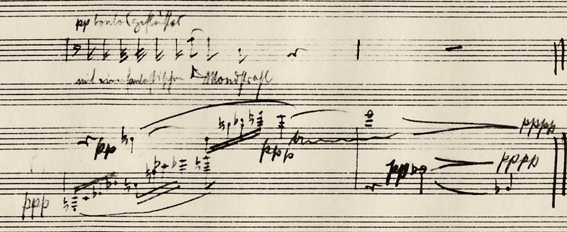
I do not know why, but I had a vision of the opera starting with fishermen finding the body of Antinous. I knew the opera wasn’t going to be a murder mystery, and that flashbacks are more cinematic, but that was my vision. To me, seeing the corpse of Antinous at the start of the opera made the love scenes even more tragic. When we finally find out why Antinous dies, the opening scene makes the love story that much more pungent. I did not have the musical idea for the opening until much later. I had the atmosphere and emotion in my head, but the music came from a few measures of an assignment I wrote for ALT (American Lyric Theater). After I heard the music being performed, I knew I had to develop it for the fishermen scene.
Not having any music in mind for the opening is why I chose not to set it for AOP’s opera scene. Instead, I wrote a libretto that would incorporate Marcus and Sabina’s love theme, Antinous and Hadrian’s love theme, Vera’s aria, and a grand quintet at the end. Even though I knew it wasn’t a dramatically viable scene, the opportunity to hear all the voices singing the themes was worth the sacrifice.
Chuck brought everything together. At first I did not know if this would be an opera about politics, love, or history. Chuck lead me to the decision that “Antinous and Hadrian” would be first and foremost, a love story. It was through Chuck that we developed the relationships, personalities, and motivations of the characters. He asked all the right questions. It was during our time together that major plot points were established. The only problem was with my writing ability. I am a mediocre writer as best, and it took me longer to write the libretto for AOP’s scene than the music. The creation of the opera was at a standstill at this point, which was not necessarily a bad thing since I was also writing my first opera, Margot Alone in the Light.
This opera would connect me to my future librettist. Margot was being premiered at operamission‘s event, ‘Opera in Flight’ along with several other works, including a piece by Edward Ficklin. It was during the rehearsal process that Eddy caught a glance at a book about Hadrian that I had left in the studio, and he asked you about it. You told Eddy about my opera, and it turned out Eddy was a bit of an expert on Roman history, and had always wanted to tell the story of Antinous and Hadrian as well. Not only was Eddy a fine composer, but a seasoned writer as well. I loved the libretto he wrote for his piece for ‘Opera in Flight,’ and we decided to have dinner to talk about the possibility of working together. At our meeting, it was apparent that we shared the same artistic ideals and wanted to tell the story in the same way. At this point I shared the music from my AOP scene, the list of characters, and the basic plot with Eddy. We subsequently had many brunches at Cafe Forant.
Clint
Tuesday, April 2, 2013, from Jennifer Peterson
Clint, this is a really good encapsulation of that vague but gigantic in-between step that has to be dealt with before you can really start writing music. I imagine every opera has a different story about this in-between period. I feel that no matter how hard I pushed and no matter what deadlines I set, Antinous and Hadrian were going to have to find their way to their opera on their own terms. I agree that Chuck was fantastic in prodding both of us with exactly the right questions. This is so important, and I’m sure you will use this skill in the other operas you write.
As it turned out, yes, Eddy not only is a wonderful writer of music and words, he is confident dramaturgically, so we were able to take where we were with Chuck’s help and, at least from my perspective, the process immediately began to flow surprisingly organically the moment we brought Eddy on board.
Eddy, it’s time for you to pipe in here. You and I also met through American Opera Projects’ Composers & the Voice workshop series; you were in the first year of these workshops, so I actually have knows you quite a bit longer than I’ve known Clint, and have worked on and performed at least four of your operas and several of your songs. As I writer of words, I only knew your blog, and vaguely remembered that you mentioned on your website that you also wrote libretti. When you spied the Hadrian book on my piano, the lightbulb in my head was a pretty bright flash. I’m so happy that we went ahead and distracted ourselves from whatever was the task at hand, because those little moments are sometimes what makes all the difference in this unpredictable world of creative arts.
Clint was keen on working with someone with whom he could have a healthy communicative relationship. He actually sees a working relationship much like a romantic one, which I found quite novel, while being intriguing and smart. Why not? I quickly saw that it was what he needed to feel free to write what was in his heart. I’m also thankful that Clint was comfortable enough with me to be open about what made him tick, as well as what inspired him.
My role in the development in this opera soon became one of simply trying to check in with the two of you as often as I felt necessary. I have always held a position that deadlines don’t necessarily encourage great art. I actually have often thought the best art comes from those who are unable to meet deadlines, but perhaps that’s just me.… Nonetheless, the two of you were totally on top of necessary deadlines on your own, and progress happened very quickly.
Eddy, can you give us a sense of why the topic of Hadrian and Antinous grabbed you in the way it did, and your perspective on this step in the process?
Jennifer
Wednesday, April 3, 2013, from Edward Ficklin:
The original spark of interest was kindled by two things. Recovering and retelling gay history is important to me and doing so through opera was irresistible. Second, a long standing if not always very deep fascination with the classical world. Watching Clint’s Margot Alone in the Light come to life as we worked on my piece clinched it. We had to do this.
I was not without a few trepidations. I had only once collaborated with a composer on an opera and that was in college. And I didn’t really know all that much about Hadrian or Antinous. I certainly recognized the names and the import and potential putting their story on the stage. Beyond that, however, I had my work cut out for me. The easy rapport that Clint and I developed erased the trepidations pretty quickly. And as I dived into the research, I really began to relish the challenging task we set out for ourselves.
The rapport soon developed into trust and that made the working relationship feel very natural to me. The relationship also, as it developed, ever so gently pulled me out of a comfort zone that I hadn’t realized I’d fallen into. If you spend some time with the operas I’ve created solo, you’ll notice they’re a bit different than Antinous and Hadrian. This libretto is new territory for me: large versus small, long versus short, and most interestingly, more emotion than idea or concept. I had spent so long poking and prodding at the boundaries of “opera” that I had never spent any time firmly in the center of the tradition. It was, ironically, a risk for me. Thankfully, a trusting collaborative relationship made the risk worth it and, if I may say so, quite a success.
Eddy
Saturday, Apr 6, 2013, from Jennifer Peterson:
I’m learning so much here! Exposing your secrets…
You both happen to be remarkably skilled at larger forms, which I would think be one of the main impediments or at least challenges in creating an opera.
I think it would be great if both of you described some specific ways in which your Antinous and Hadrian veers towards the “traditional” opera mold. Feel free to relate it to your other works, and/or relate it to traditional operas, if any have inspired you or influenced you in certain ways. I think this might help larger audiences find easier access to your work.
Jennifer
Monday, April 8, 2013, from Clint Borzoni:
For me, the two operas which influenced Antinous and Hadrian the most are La Bohème and Aïda. I have always felt Rodolfo and Mimi’s love story has been the one most genuinely captured through opera. The music and words express what love can feel like, a rare feat. Their love is simple at its core. I wanted Antinous and Hadrian’s love to be simple as well, even though it was between an Emperor and a declared god.
It was Aïda’s plot that influenced me. Everyone wants what is best, there are no villains. In Antinous and Hadrian, everyone is coming from a place of love, but sometimes love leads them astray. Marcus and Sabina want to kill Antinous so their love can prosper, Vera wants Antinous dead because of her love of her goddess, and Antinous kills himself out of love for Hadrian.
Monday, April 8, 2013, from Edward Ficklin:
There are a few technical sorts of things that I did with the libretto to put us firmly in the realm of grand opera. First, the use of heightened speech–no one talks like that! For instance, compare the way Italians on the street speak today as opposed to your typical Verdi libretto. There is also a fluid, but still present, difference between recitative and aria, both in the writing and setting of the text. I had that in mind as I was writing–more expository sections versus exploration of strong emotional state or inner conflict.
But most importantly, it’s just the feel of the whole thing. It’s a grand opera, no two ways about it!
Eddy
Tuesday, April 9, 2013, from Jennifer Peterson:
Next question:
Eddy, as you were working with historical personalities and events, how did you decide when to respect historical facts, and when to take artistic license? I imagine this is always a big dramaturgical question in historical drama, so tell us a little about the debate as it relates to these specific characters, and what you decided to do about this, and in what way.
Did your familiarity with Clint’s musical style have any bearing in your decisions? I know some of your own operas explore the supernatural and paranormal. Did you ever consider bringing non-real elements into Antinous and Hadrian?
Did you consider audiences’ expectations, or did you purely go with your gut?
And let us in a bit on your first steps in structuring the large-scale form as it relates to creating an opera libretto from scratch. We went through a number of steps between you, Clint, and myself; and I think our readers might not realize how much forethought can be required.
Jennifer
Friday, April 12, 2013, from Edward Ficklin:
Early on, Clint outlined his original premise and I liked it so we agreed to go forward with that. From there, it became a question of the interplay between the “purpose” of the work and its medium. Opera can’t convey the amount of detail that a novel or movie can. So we we were already constrained in that way. The story of Antinous and Hadrian is not that well known, so we couldn’t assume any prior knowledge on the part of the audience. Our purpose was the love story and the mix of historical and fictional elements was chosen to support that love story as told through the medium of opera. I had to make sure I effectively created their world and made it feel consistent with itself.
There’s also not a lot of historical fact to draw from in the first place. Much of Antinous’ life can’t be traced with any certainty–where he came from, how he met Hadrian, how old he was when they met. The records of Hadrian are about the emperor and not about the man and his loves. To effectively convey the love story, our primary purpose, I had to fill in some blanks, had to shift between historian and storyteller. I’m also gambling a little on the age-old “willing suspension of disbelief” that makes so much, or perhaps all, of opera work. Make the characters and setting plausible and the story compelling enough that the audience will, consciously or otherwise, put aside doubts about historical veracity.
In general, I also don’t put a lot of credence in any declarative or authoritative declarations of historical fact. Or to put it another way, “history” is mostly “story.” I know, and freely admit, I made up lot of this story. I just hope no one thinks I’m trying to pass this off as “the truth.”
It’s hard to anticipate what audience expectations are going to be, but I’m gambling on it being to experience an opera not a history lesson. (I’ll let you know after the premiere if I was right or not.)
As for the supernatural, it was not part of Clint’s original premise and I never felt any need to add anything to it. There are many ways to tell a love story, but that wasn’t what we wanted. However, depending on how you define “supernatural,” there is one character, Vera, whose actions drive much of the plot and she is motivated by religious belief and ecstatic visions. There aren’t overtly supernatural events in the story, but one character’s unflinching belief in gods affecting the actions of human kind does drive much of the action on stage.
Eddy
Saturday, April 13, 2013, from Jennifer Peterson:
I love this.
Eddy, can you tell us who the characters are in this opera? And which of them are historical, and which did you invent, and for what purpose? We’ll go into their musical/vocal requirements later, but I’d like to introduce a little more about the story here if we could.
And Clint, maybe you can tactfully answer this: you and Eddy solved a potential discord the subject of Hadrian and Antinous proposed to modern audiences in deciding that Antinous would be ‘of age’ when Hadrian met him. Since his actual age is unknown, I don’t see us as having broken any rules or told any untruths. Yet at the same time, the topic of pederasty did arise in conversations with Chuck Hudson, workshops with singers, and conversations with Eddy. We know Britten dealt with the topic in his way, and I feel that you and Eddy solved this sensitivity more elegantly than I thought possible. Can you talk about this a little bit, as Eddy is telling us more about the characters?
Jennifer
Monday, April 15, 2013, from Edward Ficklin
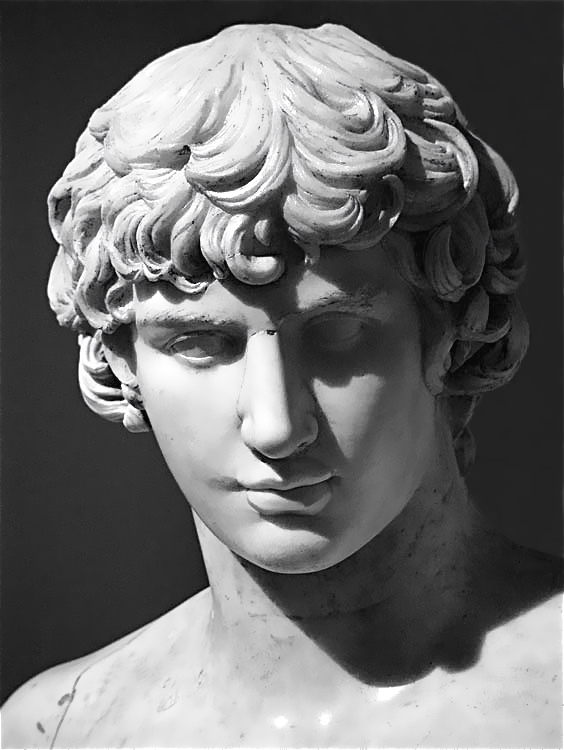
So we have, of course, our stars Antinous and Hadrian. They’re real. I drew on two main sources for the character of Hadrian, one fictional (Marguerite Yourcenar’s Memoirs of Hadrian) and one historical (Anthony Everitt’s Hadrian and the Triumph of Rome). The little bit of solid fact there is to draw on for Antinous comes from Royston Lambert’s Beloved and God.
In the opera we include the wife of Hadrian, Sabina. She was real, but there’s not much more to go on. So, we were on our own to decide how she would react to a loveless political marriage. React she did: she had an affair with a high-ranking general in the Roman army. Enter Marcus, a totally fictitious character. He and Sabina, in true Roman fashion, mix their personal love with their political ambition. Marcus is determined to be named Hadrian’s successor. Since Hadrian and Sabina have no children (historical fact), and the post of emperor was still, in theory at least, a type of “appointment” by Senate, Marcus feels he stands a good chance. In practice, the reigning emperor named a successor, who was often adopted into the family, and the Senate was cowed into submission.
Marcus and Sabina watch the love affair of Hadrian and Antinous and fear their plans for succession may be in jeopardy. They then turn to Vera, another fictitious character, for clandestine assistance in the form of poison. This is Rome, after all. Vera is a priestess of the cult of Isis, one of many, many foreign religions that made their way into Roman life. Cults and rituals from all over the empire found their way to the capital and happily co-existed with the official state religion of Rome. As such a priestess, she would be privy to arcane knowledge like herbalism. She’s happy to help, but suggests a different course: convince Antinous to take his own life. If he could be convinced to sacrifice himself for Hadrian (whose health was failing him–heart condition, most likely), then they would remain blameless. Vera does not share with her co-conspirators that she is being guided by ecstatic visions she believes are sent to her by Isis herself. Vera believes that by sacrificing himself Antinous will become a god, the consort of Isis.
Like Sabina, there is one more major character in the opera suggested by fact and filled in by fiction, Phlegon, a slave who served Hadrian as a personal assistant (to use a modern term). All the other minor characters that come and go are entirely fictitious.
TO BE CONTINUED….











 operamission